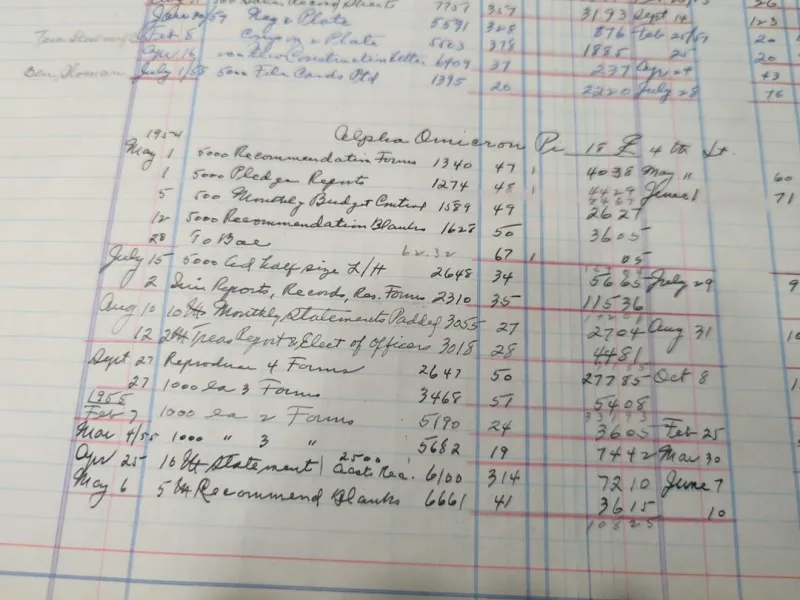
The Ledger at the Kitchen Table: When Balancing Your Checkbook Was a Monthly Ritual — Not a Lost Art

Photo by Photo by Vitaly Gariev on Unsplash on Unsplash
Picture a Sunday evening in 1974. Dinner dishes done, kids doing homework at the far end of the table. Dad — or Mom, or both — sits down with the bank statement that arrived in the mail, a pen, and a checkbook register that looks like a tiny green ledger. For the next thirty or forty minutes, they go through it. Line by line. Check number by check number. Every dollar in, every dollar out, until the register matches the statement to the penny.
If it didn't balance, you stayed until it did.
That ritual — unglamorous, slightly tedious, completely analog — was how tens of millions of American households kept track of their money for most of the twentieth century. And without anyone quite realizing it, the death of that ritual took something important with it.
The Register as a Financial Mirror
The checkbook register was a humble object. A few inches wide, printed on thin paper, with columns for the date, a description, a check number, the amount, and a running balance. Every transaction got recorded by hand, in the moment, in your own handwriting.
That last part mattered more than it sounds.
When you write something down yourself, you process it differently than when you watch a number update on a screen. The physical act of recording a purchase — writing 'groceries, $34.17' in a little column — forces a moment of conscious acknowledgment. You saw what you spent. You wrote it in your own hand. You watched the balance shrink. There was no hiding from it, and no scrolling past it.
By the time the monthly statement arrived, you'd already recorded everything in the register. Reconciling the two was a verification exercise, not a discovery process. You knew roughly what was in your account because you'd been tracking it yourself, in real time, with a pen.
Compare that to today.
The Tap-and-Forget Economy
The average American now makes more than 100 digital transactions per month. Contactless payments, automatic subscriptions, one-click purchases, app-based transfers. Money moves in and out of accounts constantly, often without any conscious decision being made in the moment.
Your streaming services renew automatically. Your gym membership charges on the 15th. Your coffee shop app reloads itself when the balance drops below ten dollars. Your Amazon purchase ships before you've had time to reconsider it.
None of this gets written down anywhere. It accumulates silently in a transaction history that most people open maybe twice a month — and usually only when something feels off.
A 2023 survey found that nearly two-thirds of Americans couldn't accurately estimate what they'd spent in the previous week without checking their bank app. Many were off by a significant margin. This isn't a character flaw — it's a structural problem. The system is designed for speed and ease, not awareness.
What the Friction Was Actually Doing
Economists and behavioral researchers have a term for this: the 'pain of paying.' When spending money involves a physical or cognitive effort — handing over cash, writing a check, recording a transaction — people feel the cost of the purchase more acutely. That feeling doesn't stop spending, but it tends to make spending more deliberate.
The checkbook register was a friction machine. Every purchase required a follow-up step. You had to go home and write it down. You had to watch the balance change. You had to reconcile it against the statement. None of that was painful, exactly, but it was effortful — and that effort kept people connected to where their money was going.
Take away the friction, and you take away the awareness. Tap-to-pay is frictionless by design. That's its entire value proposition. But frictionless spending is, almost by definition, unexamined spending. And unexamined spending tends to drift.
The Monthly Reckoning
There was something else the checkbook ritual provided that gets overlooked: a regular, structured moment of financial honesty.
Once a month, you sat down and faced your numbers. There was no algorithm summarizing your spending into a pie chart. There was no app color-coding your categories. There was just you, the register, and the statement, and whatever story they told together.
Sometimes that story was fine. Sometimes it was uncomfortable. But either way, you knew it. You couldn't avoid it, because you were the one doing the arithmetic.
Today, most banking apps offer spending summaries, category breakdowns, and trend analyses that are genuinely impressive. But there's a meaningful difference between being shown a summary and constructing one yourself. The first requires a glance. The second requires engagement. And engagement, it turns out, is where financial awareness actually lives.
Budgeting Apps Aren't the Same Thing
It's fair to point out that tools like Mint, YNAB, and Personal Capital have helped plenty of people get a clearer picture of their finances. They're useful, and for people who use them consistently, they can replicate some of what the checkbook register did.
But the key word is 'consistently.' These tools work when people actively engage with them — which requires building a habit that doesn't come naturally in a culture designed around passive consumption. The checkbook register worked partly because you had no choice. The bank statement arrived. The register needed to match it. The task was concrete, time-bound, and unavoidable.
Budgeting apps are optional. They require initiative. And for most people, that's a meaningful barrier.
Then and Now
The checkbook is nearly extinct. According to the Federal Reserve, check usage has fallen by more than 70 percent since 2000, and among younger Americans, writing a check is practically a novelty. The register that went with it has followed.
What replaced it is faster, more convenient, and in many ways more powerful. Digital banking gives you access to your transaction history any time, on any device, with more detail than any handwritten register could hold.
But convenience and awareness aren't the same thing. The family sitting at the kitchen table with a pen and a statement wasn't just doing accounting. They were paying attention. They knew, in a specific and personal way, what their money was doing.
That kind of knowing is harder to come by now. Not because the information isn't available — it's more available than ever. But because the system no longer requires you to go looking for it.
The register didn't just track the money. It kept the person connected to it. And that connection, quiet and unglamorous as it was, turned out to matter quite a lot.